
Sticker Mosaic Art for Kids: 3 Ways to Make One
Sticker mosaic art is any picture a child completes by placing small colored pieces into marked spaces. There are three practical ways to make one at home: hand-cut dot stickers, a store-bought mosaic kit, or a design you generate yourself online in about a minute.
Search sticker mosaic art for kids and you get two kinds of results: shopping pages for kits, and craft blogs from a decade ago showing round color-coding dots stuck onto printer paper. Both of those are real answers. Neither one is the whole answer anymore, and the differences between them matter more than the SERP suggests.
Here is how the three routes actually compare when you are the parent doing the setup.
The three ways to make sticker mosaic art
| DIY dot stickers | Store-bought mosaic kit | Online mosaic maker (QrdyCraft) | |
|---|---|---|---|
| What you need | A roll of ½" color-coding dots, paper, a pencil outline you draw | The box — usually $10–$20 | A browser and about a minute |
| Setup time | 10–20 minutes of drawing the grid or outline yourself | None, once it arrives | About a minute |
| Who picks the subject | You, if you can draw it | The publisher | You — type any subject |
| Where the child works | Paper only | Paper only | Any screen, drag-and-drop, or printed on paper |
| Reuse | Redraw it each time | No — each page is used once | Replay or reprint any time |
| Sharing with a cousin or class | Make another one by hand | Buy another kit | Send a link or QR code |
| Cost | A few dollars for 1,000 dots | $10–$20 per kit | 100 free mosaics a month |
| Where it wins | Cheapest, fully tactile, no screens at all | Beautiful printed art, real peel-and-stick feel | Instant, repeatable, any subject, shareable |
That last row is the honest summary. If your goal for a rainy Saturday is no screens whatsoever, a roll of dot stickers and a hand-drawn outline is genuinely hard to beat, and it costs almost nothing. If you want polished illustration on nice stock, the Melissa & Doug and StickTogether kits deliver exactly that. What neither one does is let the same picture exist on a tablet, on paper, and on a cousin's screen in another state.
What the pieces actually look like
Every mosaic starts as a plain silhouette and gets cut into polygon pieces. Nothing is drawn by hand per design — the shape is traced, then tessellated, then colored from a palette you choose. Here is the same hot air balloon at both stages:

Before — the plain hot air balloon silhouette the design starts from.
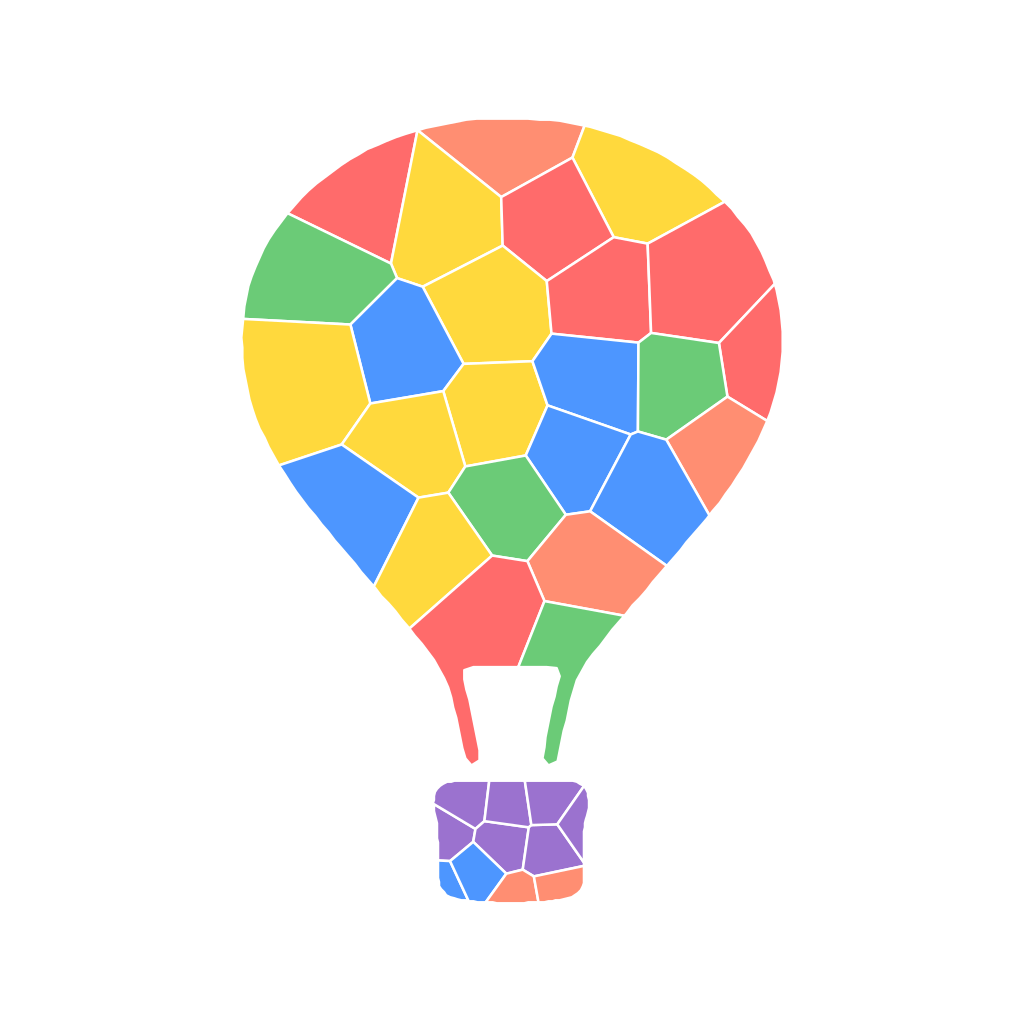
After — the same silhouette split into 36 pieces on the medium setting, vibrant palette.
The pieces on the right are what a child moves. On a screen, each one snaps into its slot when it lands close enough, so a seven-year-old is not fighting the interface. Printed, those same 36 pieces come out as a numbered sticker sheet plus a numbered outline page — the same job, with real peeling.
How it works: three steps
- Describe the picture. Type a subject — "hot air balloon", "sea turtle", "fire truck" — and pick a palette. This part is a parent job, which is why it takes about a minute and why there is nothing for a child to sign up for.
- Choose easy, medium, or hard. This sets how finely the picture gets cut. Easy suits ages 4–6, medium 7–9, hard 10–12. The piece count is the real difficulty dial, not the subject.
- Hand it over — screen, paper, or both. Give them the tablet, or print the sheet. Send the QR code and a cousin can do the same picture on their own device.
Piece count matters more than the age label
Age ranges on craft boxes are a rough guide. Piece count is what actually decides whether a child finishes happily or wanders off. Here is the same process on the easy setting:

An easy rainbow: 26 pieces. Roughly fifteen minutes for a five-year-old.
Twenty-six pieces versus thirty-six sounds like a small gap. In practice it is the difference between a finished picture on the fridge and an abandoned one on the table. If your child has never done a mosaic, start easier than you think. Our guide to what age paint by sticker is for breaks the ranges down, and what a mosaic sticker book is covers the printed format if that is the version you grew up with.
What the activity is actually good for
Sticker mosaics sit in a useful spot between a puzzle and a coloring page. Placing a small piece precisely is a pincer-grip task, which is the same motion as holding a pencil. Matching a piece to its slot is visual discrimination. And because the picture becomes recognizable long before it is finished, children get a steady drip of progress rather than one payoff at the very end — which is usually why they keep going.
None of that requires a specific product. A hand-drawn outline and a roll of dots does it. The reason to make one online is repetition: this month it is dinosaurs, next month it is rockets, and you are not buying a new kit each time.
That is also why the free tier is stated plainly rather than buried: 100 free mosaics a month, which is more than one a day. For most families that is simply the whole product — you would have to be running a classroom to reach it.
Make your first mosaic at craft.qrdyai.com → — type a subject, pick a palette, hand over the screen.
If you would rather start from a finished design than type anything, the hot air balloon mosaic in our gallery and the rainbow mosaic are both ready to play or print as-is.
A fair word for dot stickers and boxed kits
The 2016-era craft blogs got something right that is worth repeating: a child sticking small squares onto their own drawing is doing more creative work than a child filling in someone else's outline. If your kid wants to design the picture, hand them the dots and let them invent it. A generator is the wrong tool for that.
Boxed kits win on materials. Foam squares, vinyl stickers, thick board — those feel good in a way printer paper does not, and the peel is half the pleasure. If a long car ride is the use case and screens are off the table, buy the box.
Where both run out is repetition and reach. One picture, one child, one time. Made online, the same picture is unlimited and it travels.
FAQ
What age is sticker mosaic art good for? Ages 4 to 12 covers it, with piece count doing the real work: around 25 pieces for ages 4–6, 35–60 for 7–9, and 90 or more for 10–12. Younger children can join in on any of them if an adult places the fiddly pieces.
How do you make mosaic art with stickers at home? Draw a simple bold outline, divide it into rough regions, and let your child fill each region with color-coding dot stickers from an office supply roll. Simple shapes work best — a fish, a heart, a rainbow. For a numbered, pre-cut version, use a kit or generate one online and print it.
What is the difference between a sticker mosaic and a paint by sticker book? A sticker mosaic is built from many small, similar shapes that tile a picture. Paint by sticker books use larger numbered pieces cut to fit specific regions of an illustration. The motion is the same; the sticker mosaic tends to be more geometric and more forgiving.
Is sticker mosaic art good for fine motor skills? Peeling and placing small pieces uses the pincer grip and requires controlled placement, which is the same physical skill set as early handwriting. It is not a substitute for occupational therapy, but as a quiet-time activity it asks more of small hands than a coloring page does.
Can you make sticker mosaic art for free? Yes, two ways. Dot stickers and paper cost a few dollars total. Online, 100 mosaics a month are free at craft.qrdyai.com, which is more than one a day — paid plans exist for people who need more, but most families never get close.
Can two children do the same picture? Online, yes — share the link or QR code and each child gets their own copy to fill in. Nothing is used up, so one design can go to a whole classroom. A printed kit page can only be done once.
Frequently asked questions
What age is sticker mosaic art good for?
Ages 4 to 12 covers it, with piece count doing the real work: around 25 pieces for ages 4-6, 35-60 for 7-9, and 90 or more for 10-12. Younger children can join in on any of them if an adult places the fiddly pieces.
How do you make mosaic art with stickers at home?
Draw a simple bold outline, divide it into rough regions, and let your child fill each region with color-coding dot stickers from an office supply roll. Simple shapes work best - a fish, a heart, a rainbow. For a numbered, pre-cut version, use a kit or generate one online and print it.
What is the difference between a sticker mosaic and a paint by sticker book?
A sticker mosaic is built from many small, similar shapes that tile a picture. Paint by sticker books use larger numbered pieces cut to fit specific regions of an illustration. The motion is the same; the sticker mosaic tends to be more geometric and more forgiving.
Is sticker mosaic art good for fine motor skills?
Peeling and placing small pieces uses the pincer grip and requires controlled placement, which is the same physical skill set as early handwriting. It is not a substitute for occupational therapy, but as a quiet-time activity it asks more of small hands than a coloring page does.
Can you make sticker mosaic art for free?
Yes, two ways. Dot stickers and paper cost a few dollars total. Online, 100 mosaics a month are free at craft.qrdyai.com, which is more than one a day - paid plans exist for people who need more, but most families never get close.
Can two children do the same picture?
Online, yes - share the link or QR code and each child gets their own copy to fill in. Nothing is used up, so one design can go to a whole classroom. A printed kit page can only be done once.